 Audi tenebras inter cortices
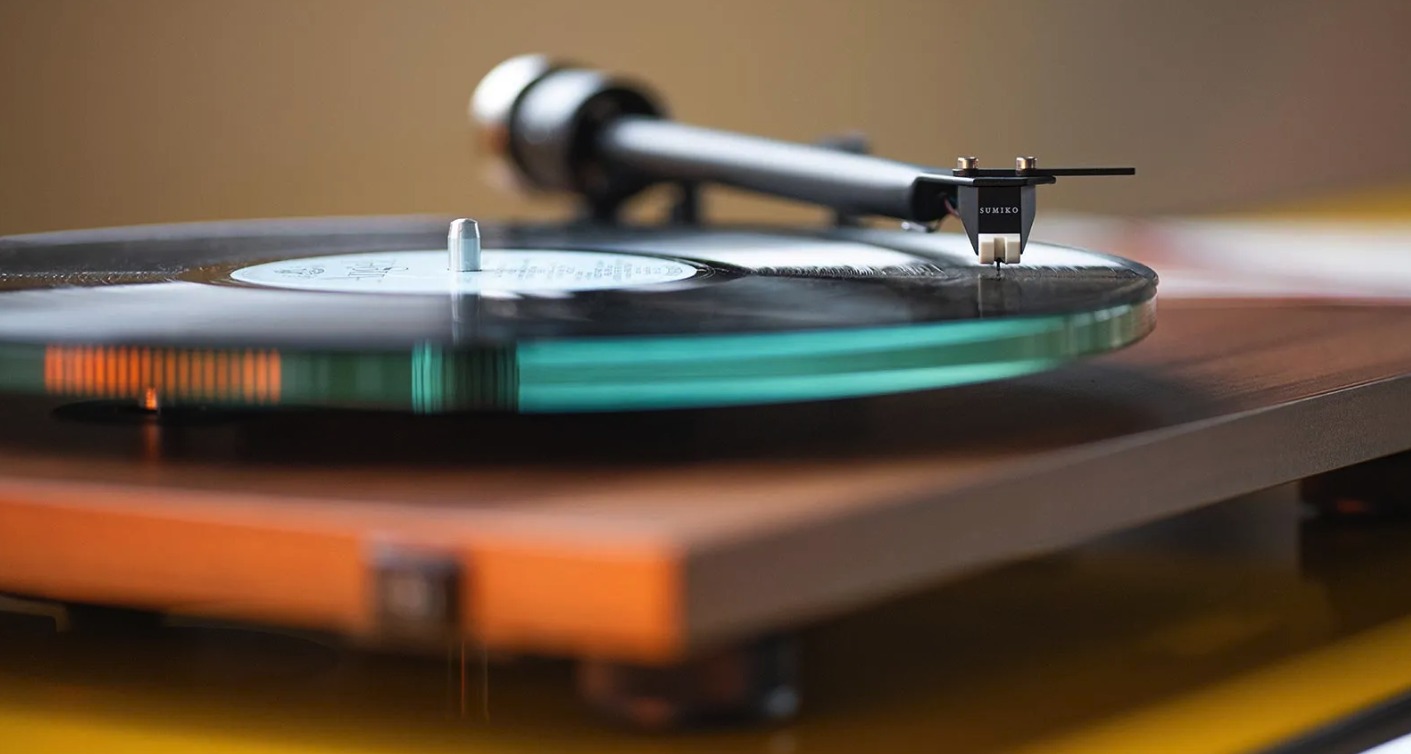
It is night, in a small room in a flat. The music is on, but not loud. A black metal album is spinning, and what I want is simple: to hear the wall of guitars in layers, not as a single block. Every question I had while putting this system together came out of that one need. I wasn't chasing volume; I wanted the music not to collapse when the volume comes down, with micro-detail, stereo separation, speed and controlled bass all kept intact at low and moderate levels.
The music I listen to demands the same. Most of it is black and death metal, with post-rock, dark jazz, darkwave and synthwave alongside. Here I describe the system I settled on by following the path the signal takes, from source to speakers.
The limit of the ear
One thing has to be admitted first: the real limit of low-volume listening lies not in the equipment but in the ear. The human ear does not hear every frequency with the same strength. Harvey Fletcher and Wilden Munson were the first to measure this, in 1933; the curves that apply today were redefined in 2003 as the ISO 226 standard, by combining measurements from different countries. The ear is most sensitive roughly between 2 and 5 kHz, largely because of the resonance of the ear canal. As the volume drops, these curves steepen in the bass region. In other words, at night-time levels the bass and the very top of the treble reach the ear more weakly, however much of them is in the recording.
That is why no system can hold full tonal balance at something close to a whisper. For me the goal was for separation and detail to stay legible at a normal night-time listening level. It is striking, too, to see how little energy that physically takes. My speakers produce 86 decibels at one metre for one watt. For a listening level of around 70 decibels at roughly two metres, the power needed is about a tenth of a watt. In night listening what matters is not the amplifier's power but how it behaves at such tiny outputs.
Belt, glass and arm
At the head of the chain is the Pro-Ject T2 Super Phono. It sits in the class the Austrian maker calls "audiophile entry level", but it is a noticeably more serious platform than the T1 it builds on. An electronically regulated AC motor drives the platter via a belt; switching between 33 and 45 rpm is electronic too, so there is no need to move the belt by hand. The logic of belt drive is simple: it isolates the platter from the motor's vibration.
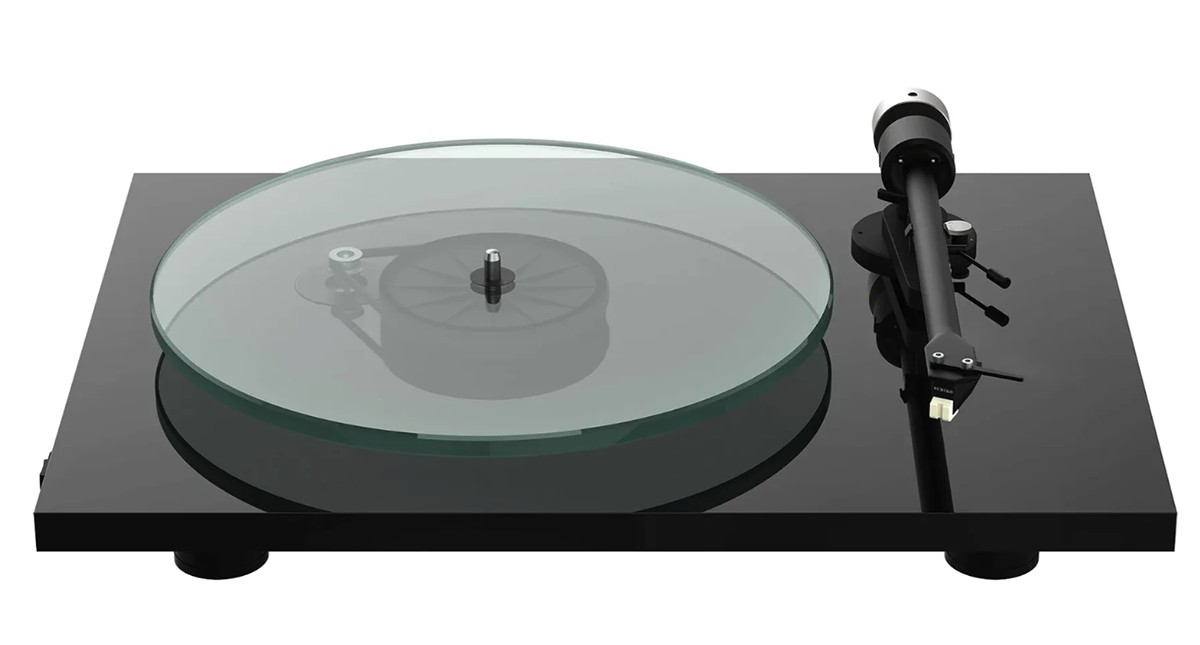
The belt turns a sub-platter first. The sub-platter spins on a hardened steel spindle in a brass bearing; Pro-Ject gives the tolerance of this bearing as a thousandth of a millimetre. The main platter is tempered glass, 10 millimetres thick and weighing 1.7 kilos. A heavy platter acts like a flywheel, smoothing out small fluctuations in speed. The plinth has no plastic parts and no hollow space left that could resonate. Even so, the turntable needs to stand on a flat, solid surface away from vibration.
The arm is a nine-inch, one-piece aluminium tube. Its effective length is 230 millimetres, its effective mass 9.5 grams. The anti-skating mechanism, which counters the skating force, is spring-based. At the end of the arm is the Sumiko Rainier, and that choice matters for the long life of the system.
Stylus and resonance
The Rainier is a moving magnet (MM) cartridge, hand-assembled in Japan by Excel Sound in Yokohama. It carries an elliptical diamond tip on an aluminium tube cantilever, has an output of 5 millivolts, weighs 6.5 grams and tracks at 2 grams. What makes it valuable is its replaceable stylus. Sumiko's Rainier, Olympia, Moonstone, Wellfleet and Amethyst share the same body and interchangeable styli. So without changing the cartridge body, just by upgrading the stylus, I can move to a better cantilever and a better diamond tip.
The match between an arm and a cartridge rests on a concrete calculation: the arm and the stylus compliance together form a spring-mass system, and that system has a resonant frequency. This frequency should generally fall between 8 and 12 Hz. Lower, and it responds to warps in the record and to footfall; higher, and it mixes into the lowest bass of the music. The calculation is simple: 159 divided by the square root of the product of total mass and compliance.
The T2's arm is 9.5 grams, the Rainier 6.5 grams; with the screws, around 16.5 grams in total. The Rainier's compliance is given as 10 units at 100 Hz. Japanese manufacturers quote this figure at 100 Hz; to convert it to the 10 Hz value the calculation uses, it is usually multiplied by a factor of between 1.5 and 2. That puts the resonance at roughly 9 to 10 Hz, right in the desired range. This is an approximation; the real value can only be measured with a test record.
The RIAA curve
The 5-millivolt signal from the cartridge cannot be fed straight into an amplifier, because when records are cut the bass frequencies are reduced and the treble is boosted. The bass is reduced because its wide excursions widen the grooves and shorten the playing time that fits on a record. The treble is boosted because when it is brought back down on playback, surface noise is pushed down with it. This curve has been standard under the name RIAA since the 1950s. The phono stage's job is both to amplify the signal and to apply the exact inverse of this curve.
For this the T2 uses a circuit Pro-Ject calls "dual-stage split passive". As SoundStage's review explains it, the design splits the high- and low-frequency parts of the RIAA curve between two separate circuits. It is a more expensive solution, but it means a closer match to the curve, that is, more accurate playback of the music cut into the record. Pro-Ject normally uses this design in its separate phono stages. If needed, the circuit can be switched off with a button, which leaves the door open for anyone who later wants to move to a low-output moving coil (MC) cartridge.
A digital amplifier
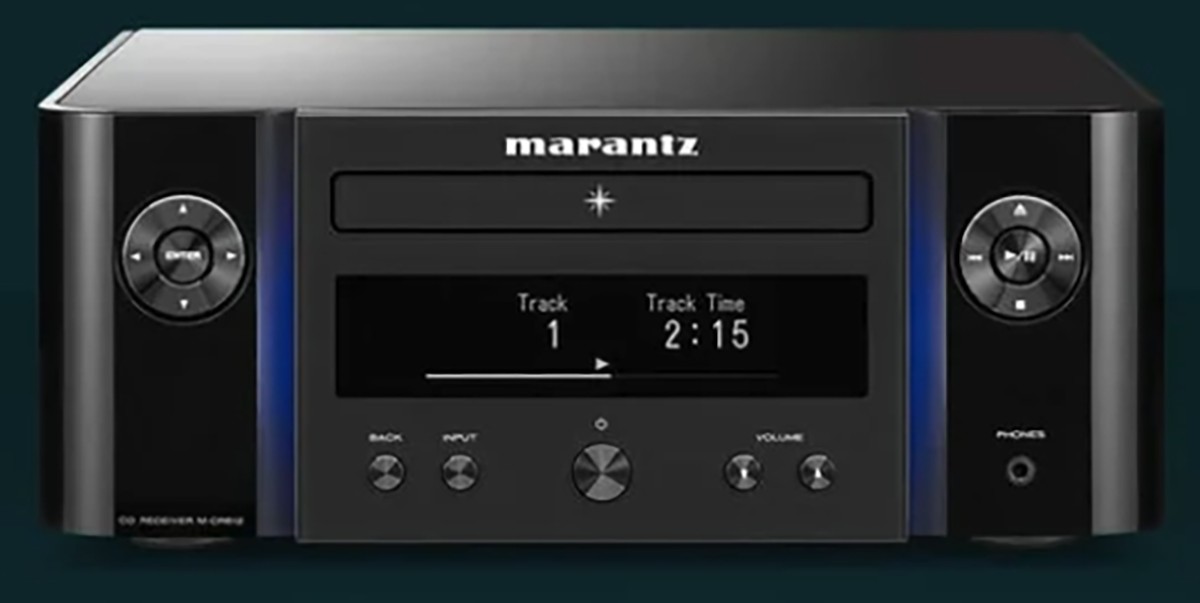
In the middle sits the Marantz Melody X M-CR612. In this chain it is not only an amplifier; it brings together a CD player, network streaming and digital inputs in a single box. On paper it delivers 50 watts per channel nominal and 60 watts dynamic into 6 ohms, and it can drive speakers from 4 to 16 ohms.
The M-CR612's architecture is interesting. According to HiFiReport's circuit analysis, it is a "pure digital" amplifier. The digital signal first passes through sample rate conversion and volume control in a Texas Instruments TAS5558 processor, then goes straight to the switching output stages, and only becomes an analogue waveform again in a filter at the speaker outputs. There is no separate DAC stage along the way. This architecture has an interesting consequence for me: when the turntable's analogue signal enters the amplifier, it too has to be converted to digital so that this processor can work. So in this chain even vinyl does not reach the speakers by a purely analogue path. I take this as the reality of the system, not as a flaw.
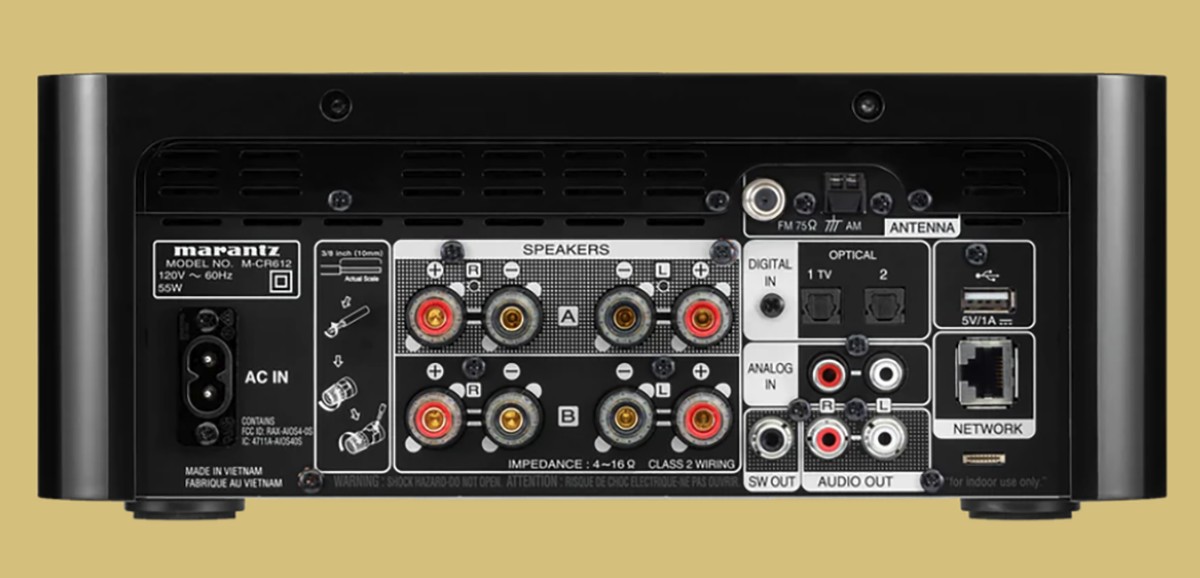
There are four power channels inside the amplifier. In parallel BTL mode the channels are combined to deliver more current to a single pair of speakers. In bi-amp mode, two channels drive the speaker's mid/bass driver and the other two drive the tweeter, separately. This is only possible if the speaker has a split crossover and two pairs of binding posts. The Bronze 50 7G has both. The tone controls are also a tool for low-volume listening: bass and treble can be adjusted by up to 10 decibels, and there is also Marantz's dynamic bass boost. It is also a way of putting back the bass the ear loses at night-time levels.
I bought the system for vinyl. But streaming is excellent too, and my CDs, gathering dust on the shelf for years, have come back to life. What I first thought of as a vinyl setup became, thanks to the Marantz, a system in which all my music plays through the same speakers. Vinyl, CD and streaming stand side by side in this chain and, given the M-CR612's architecture, all three end up passing through the same digital processor.
A ceramic-coated cone
At the end of the chain is the part that really sets the character of the system: the Monitor Audio Bronze 50 7G. It is the seventh generation of the entry series Monitor Audio has been making for twenty-six years. A two-way, rear-ported bookshelf speaker. The mid/bass driver has grown from the previous generation's 130 millimetres to 150 millimetres, and its magnet system and voice coil have been improved. The cone material is what Monitor Audio calls C-CAM, a ceramic-coated aluminium-magnesium alloy. The material is light and very stiff; it lets the cone move like a piston, without flexing. Flexing in the cone is one of the sources of distortion.
The tweeter is a 25-millimetre gold-coloured C-CAM dome. In front of it sits a waveguide that shapes the dispersion. According to Hi-Fi News, the tweeter's off-axis behaviour is very consistent; even when the speaker is not aimed straight at the listener, the treble balance changes little. The crossover point between the two drivers is 3 kHz, and the network is split into separate sections for bass and treble. The front baffle is 18-millimetre plywood; the drivers are secured with bolts that run to the back of the cabinet. The aim is to stop the cabinet itself from vibrating.
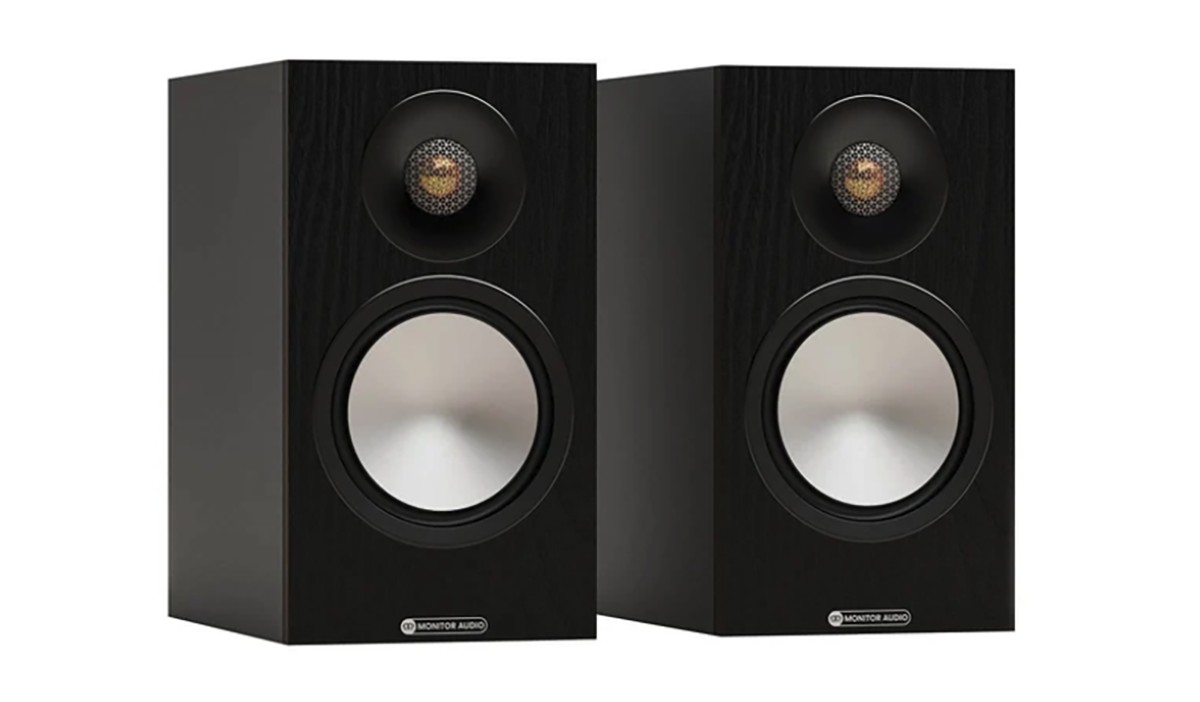
The bass is reinforced by a rear port tuned to 47 Hz. The port design, which Monitor Audio calls HiVe II, is built to accelerate the air with less turbulence. In-room frequency response goes down to 41 Hz. Nominal impedance is 8 ohms, with a minimum of 4 ohms at 200 Hz. Sensitivity is 86 decibels; by today's standards not an efficient speaker, but at my listening level that makes no difference.
Hi-Fi News's November 2025 review describes it as a speaker with deep but controlled bass and a balanced midrange and treble, and finds it more successful than some bookshelf speakers at twice the price. The same review says the speaker presents the soundstage as a wide curtain rather than a pin-sharp image.
Placement
As a rear-ported speaker moves closer to the wall its bass rises, because the port and the rear wall work together. Monitor Audio recommends 15 to 30 centimetres from the rear wall, and for those who have to place the speakers very close to the wall it supplies bungs to block the ports. The tweeters should be close to ear height. According to the manual, the speakers are designed to be toed in slightly, their axes crossing at a point a little behind the listener. If the stereo image is being lost, it suggests toeing them in a little more; for a more airy sound they can be pointed straight at the listening position, or straight ahead to reduce it. Hi-Fi News notes that the front grilles should come off for the best results.
This system is not an ultra high-end installation, but it is a compact, serious stereo chain well above package systems. I bought the system from Voxhifi.
The point of this setup is not to shake the house. It is to open up the inside of a recording in a small room at low volume: to make the wall of guitars legible in black and death metal and, in post-rock and dark jazz, to keep the stage and the air around the instruments from getting lost.
- Pro-Ject T2 Super Phono
- Pro-Ject's product copy
- AnalogPlanet (September 2024)
- SoundStage! Access (July 2024)
- AVForums (June 2024)
- Sumiko Rainier
- Sumiko's official page
- What Hi-Fi
- Dagogo (2021)
- Arm and cartridge resonance
- The formula and the 8–12 Hz target: technical discussions on Remusic and the WBF forum
- Marantz M-CR612
- Marantz owner's manual
- HiFiReport: circuit analysis
- Son-Vidéo blog (2019)
- audioFi (2020)
- Monitor Audio Bronze 50 7G
- Monitor Audio's official page
- Hi-Fi News, Mark Craven's review and Paul Miller's lab report (November 2025)
- Sound Advice (July 2025)
- Equal-loudness contours
- ISO 226:2003
- Fletcher and Munson (1933)