 Audi tenebras inter cortices
Battle Jacket: Armour Built Stitch by Stitch
In February 2019, in a federal court in Santa Ana, California, the US government was seeking to seize a motorcycle club's back patch. The Mongols club had been convicted the previous December of organised crime and conspiracy; prosecutors now wanted the trademark rights to the figure the club had used since 1969, a Genghis Khan-like rider on a motorcycle. According to the prosecutors, members wore the patch "like armour". Judge David Carter denied the request: displaying a membership patch was a way of saying one belonged to a community, and that was constitutionally protected expression.
The same word turns up in metal scholarship. Lauren O'Hagan of Cardiff University titled her 2021 article "My Musical Armor", and the book by the painter and researcher Tom Cardwell, published in 2022, is called Heavy Metal Armour. A courtroom and two academic studies, each unaware of the others, arrive at the same metaphor for the same garment. The battle jacket is not a form the metal scene invented from nothing. It is a surface on which war-surplus material has been filtered through subcultures and reworked, each new owner writing over the last. Every patch on it is the record of a choice, an exclusion and a position taken.
From the nose of the plane to the shoulder
The story usually begins with the Second World War, and for once the common account has something to stand on. American bomber crews had their aircraft's nose art painted on the backs of their flight jackets, most often the A-2 leather type, and tallied completed missions and downed targets with small marks. The jacket sat somewhere between an identity card and a service record. Cardwell reaches further back still, to the armorial tabards of medieval knights and to the costumes of English folk dances decked with badges and ribbons.
The most unexpected precursor, though, is in Japan. Samurai of the Edo period wore woollen war coats over their armour to keep off the weather; the coats were adapted from European garments that had reached Japan in the sixteenth century. The Japanese version was often sleeveless and looked like a vest. One example belonging to the Tokugawa family has the name of the plant in the family crest embroidered on its back in an old script. Here is a sleeveless vest, worn over armour and carrying an emblem of belonging on its back, centuries before the metal fan's vest.
The name "battle jacket" itself is not as old as one might think. As O'Hagan reports, metal fans born in the 1950s and 60s say that through the seventies they called the garment a "cutoff" or "kutte", and first heard the term "battle jacket" in the eighties, when patches began to be sold at concerts. The German word "Kutte" actually means a monk's habit; bikers, and after them metal fans, carried the word over to the sleeveless vest. Today the same garment goes by battle vest, patch jacket, cut-off or kutte, a sign that it comes from several traditions laid one over another rather than from a single origin.
Hollister and the one per cent
Some of the soldiers back from the war found speed and company in motorcycle clubs. On 4 July 1947 a rally organised by the American Motorcyclist Association (AMA) in the small town of Hollister, California, drew far more people than expected, around four thousand. Some fifty were arrested for minor offences such as public drunkenness. On 21 July Life magazine ran a photograph of a man slumped on a motorcycle surrounded by beer bottles. Local witnesses said the shot had been staged, but a weekend's rowdiness had become a national moral panic.
The "one per cent" label was born here too. As the story goes, the AMA declared that ninety-nine per cent of motorcyclists were law-abiding, and the "outlaw" clubs turned the remaining one per cent into a badge of honour. The AMA has always denied making any such statement and says there is no trace of it in its records. So one of the most famous biker patches is probably an answer to a sentence that was never spoken. Frank Rooney's story, inspired by Hollister, was published in Harper's in 1951 and became the film The Wild One in 1953. The Perfecto-style leather jacket Marlon Brando wore in the film would become the next generation's uniform.
In the outlaw clubs the vest followed a strict order that showed rank and belonging. The club name, the emblem and the territory sat on the back as three separate pieces; the small patches on the chest told of office and history. Cardwell traces this semi-military order to the war veterans who founded the clubs. The Mongols case shows how seriously the order is still taken: the design on the back of a jacket can become the subject of a federal case that runs for years.
Ton-up boys and run patches
On the other side of the Atlantic, in the fifties, Britain's rockers and the young bikers known as "ton-up boys" decorated their leather jackets with motorcycle marques, club badges and patches called "run patches". These patches recalled a particular ride, a particular meet. According to Cardwell, their function was almost exactly the one metal fans would later give to concert patches: proof of having been there. Twenty years on, a patch bought from the merch stand at a metal gig would go on doing the work of a run patch.
Special attack uniform in Tokyo
In Japan the same logic took an entirely different form. In the seventies the bōsōzoku motorcycle gangs of Tokyo's working-class districts began wearing long embroidered coats and overalls called tokkōfuku. The word means "special attack uniform" and is usually linked to the kamikaze pilots. According to the experts the Japan Times spoke to, however, the link is weaker than assumed: these outfits were inspired by the military jackets worn by right-wing groups, and before them gang members wore work jackets and Hawaiian shirts. The large kanji embroidered on the back of the tokkōfuku carried the gang's name; on the breast pocket there might be a challenge, "Kenka jōtō", roughly "Come and have a go".
The best-known document of this culture is Mitsuo Yanagimachi's 1976 documentary God Speed You! Black Emperor. The film follows a bōsōzoku gang called the Black Emperors. Years later a music collective in Montreal would take its name from the film. In this roundabout way an embroidered biker jacket left a trail across two continents and two kinds of music.
Painted leather and black surplus
Punk inherited this legacy in the mid-seventies, but worked with a different material. The punk jacket was mostly the leather biker jacket, and the band names on it were more often painted by hand than sewn on as patches. Chains, studs and political slogans went onto the surface too. Where the metal jacket had an orderly grid of patches, the punk jacket had the brushstroke and one-off handwriting. In later years goths and crust punks also took up painted leather as a way of making a jacket their own.
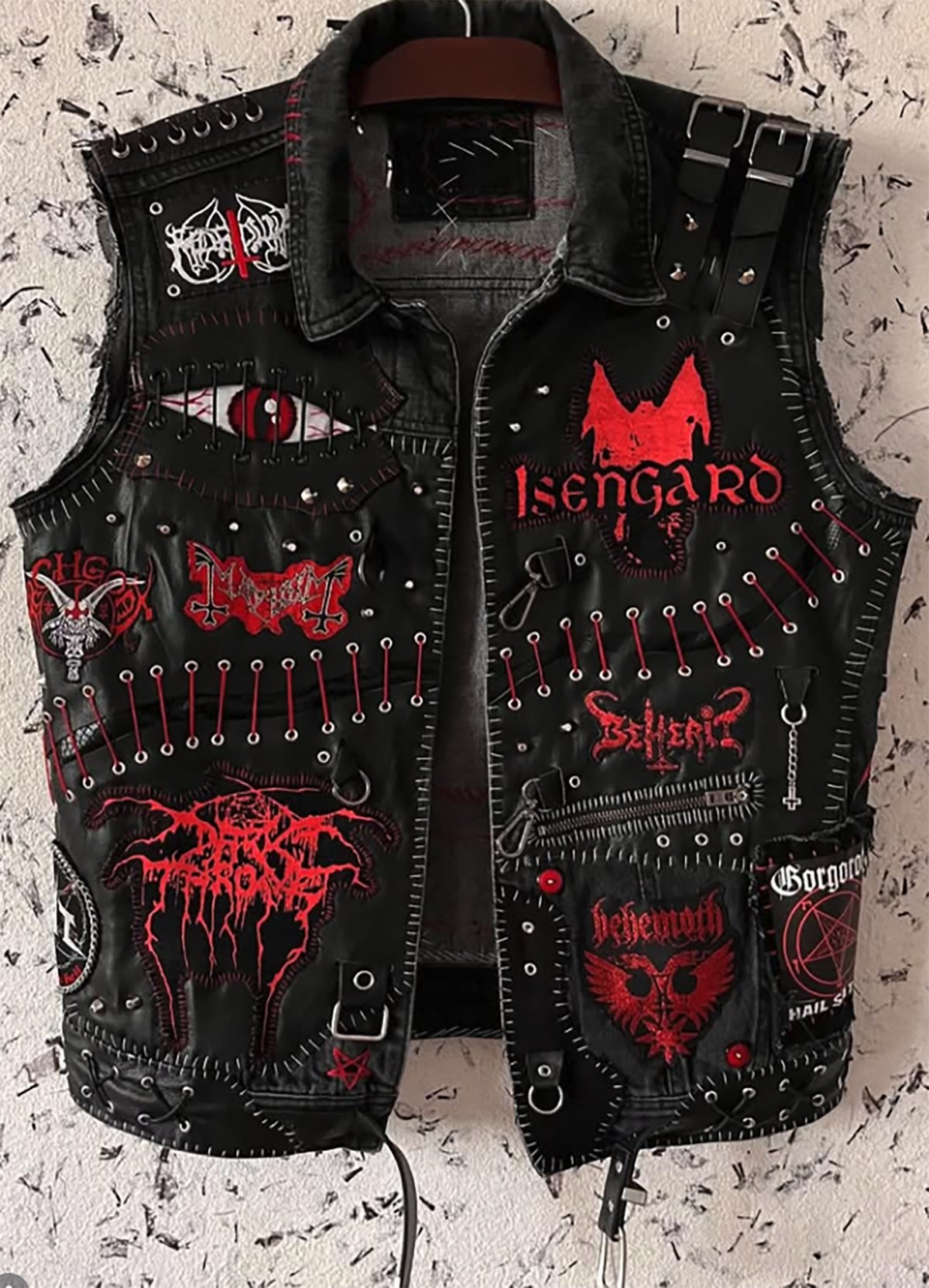
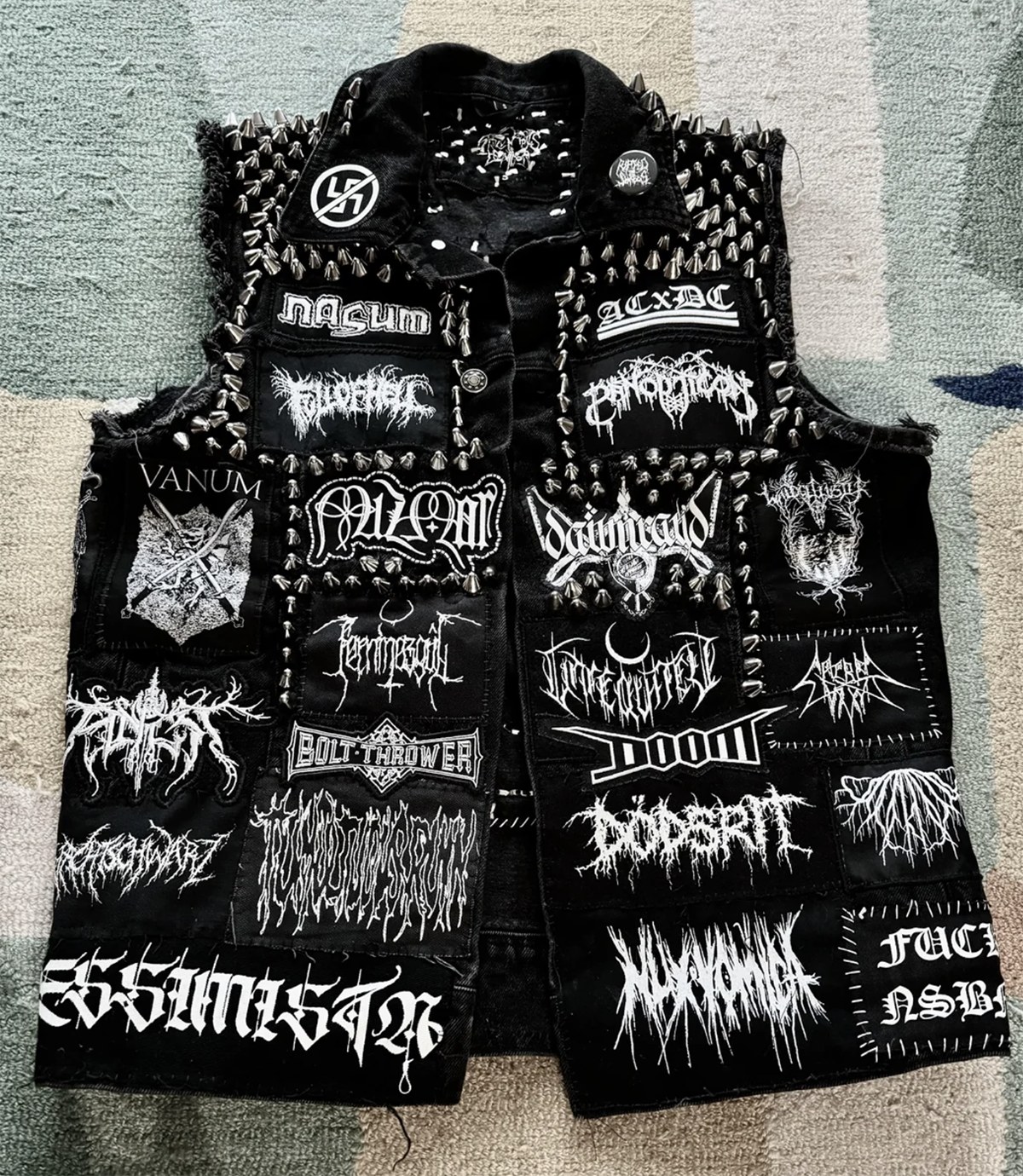
Crass, formed in England in 1977, rejected colourful, showy punk clothes and built a uniform out of black army surplus. In the anarcho-punk scene jackets filled up with stencilled symbols and slogans; the Crass logo was among the best known of them. Crust punk took the process further. An aesthetic took shape in which patches were sewn on with found or cheaply bought materials, even, the story often goes, with dental floss, and black denim vests were worn unwashed for years. On a punk jacket a patch often announced a stance rather than a band. The "Nazi Punks Fuck Off" patch, after the Dead Kennedys song, with its crossed-out swastika, is the clearest example: the jacket also said who did not belong in the scene.
Denim and leather
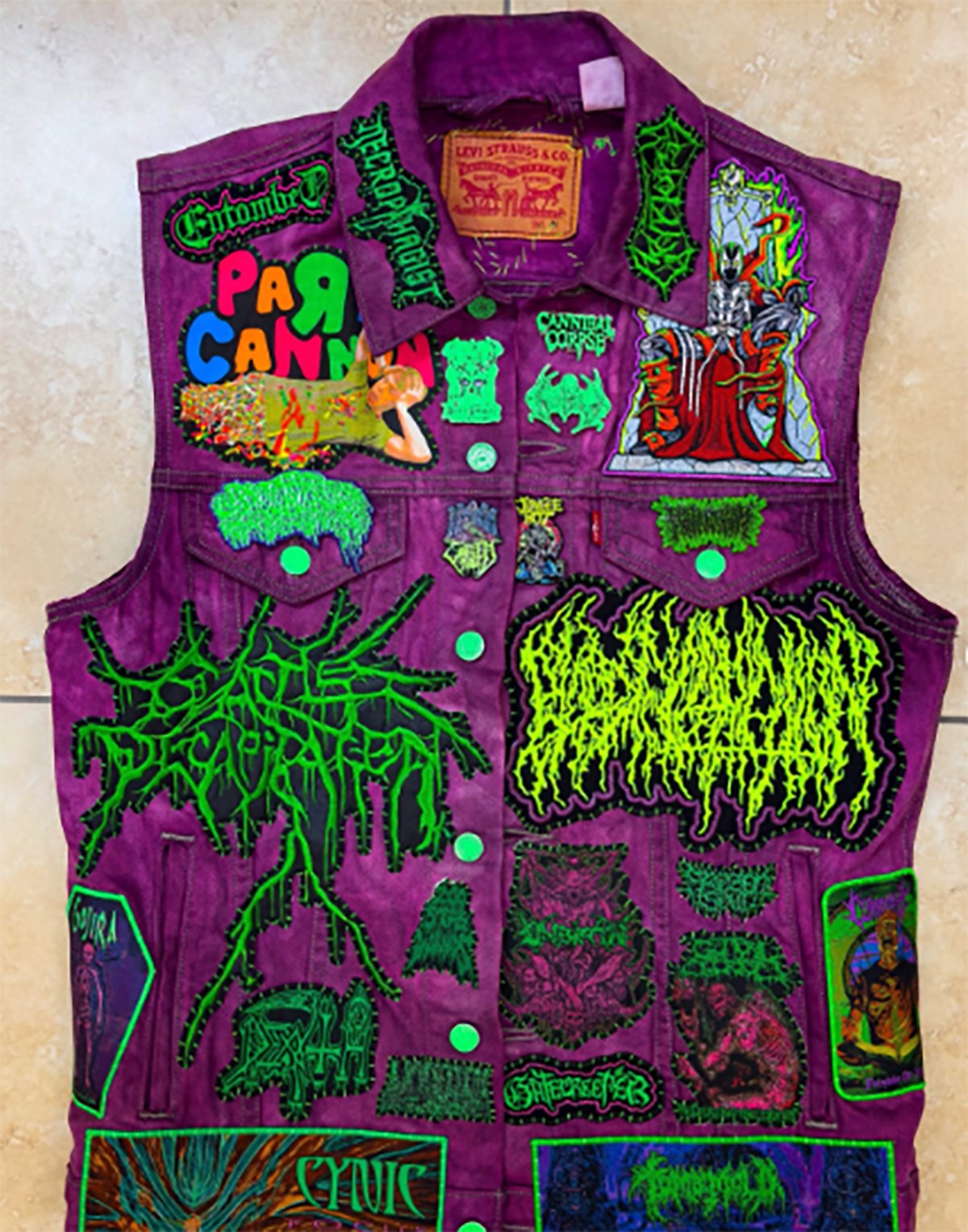
The metal fan's jacket was already established in the seventies. In the years before ready-made patches, fans embroidered band logos by hand. Once bands began selling patches, the patch became a souvenir of a particular tour, a particular concert. A patch sold at the merch stand proved that its wearer had been there that night. According to Cardwell, this is why a heavily patched vest became a document of how much its owner had invested in the subculture.
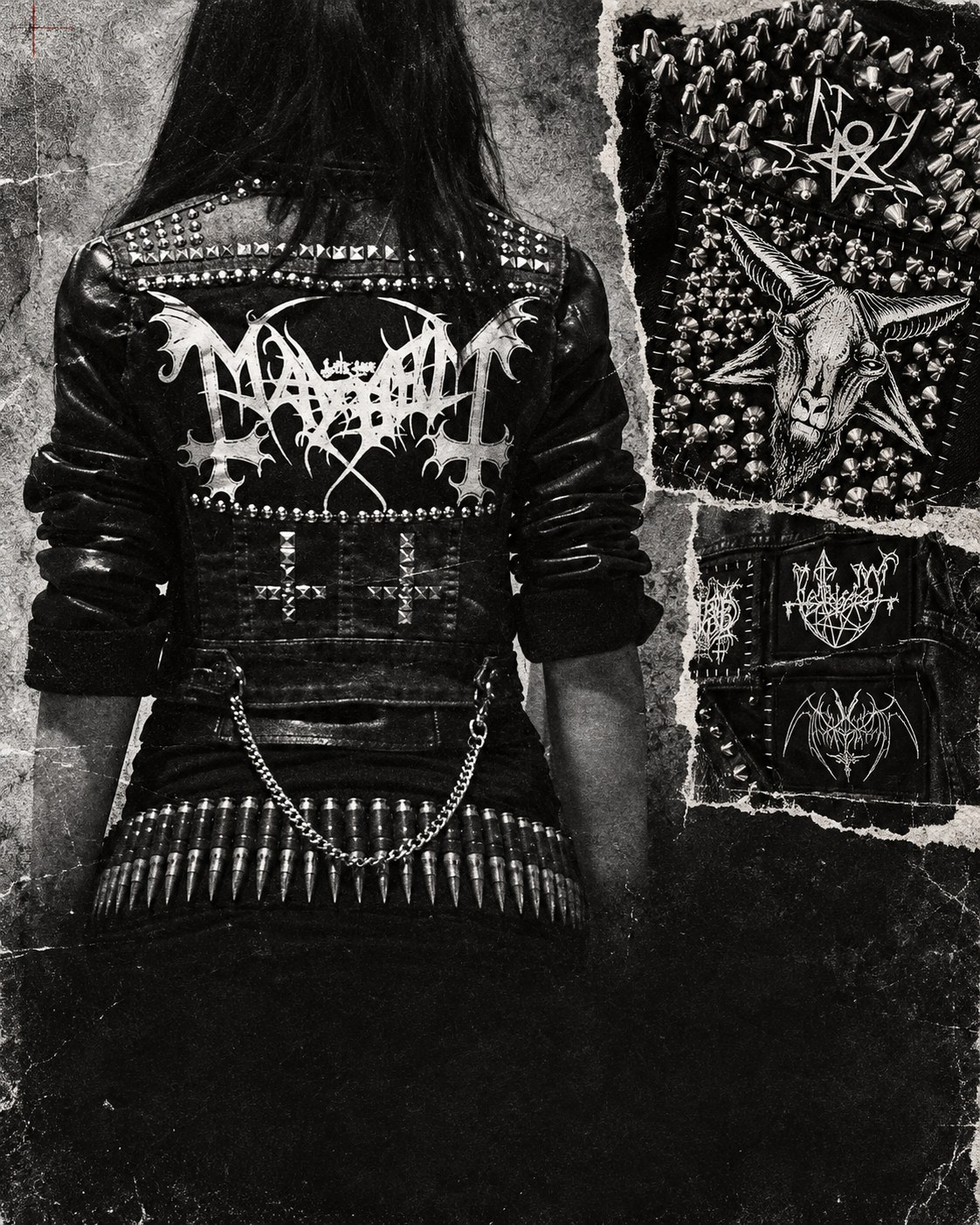
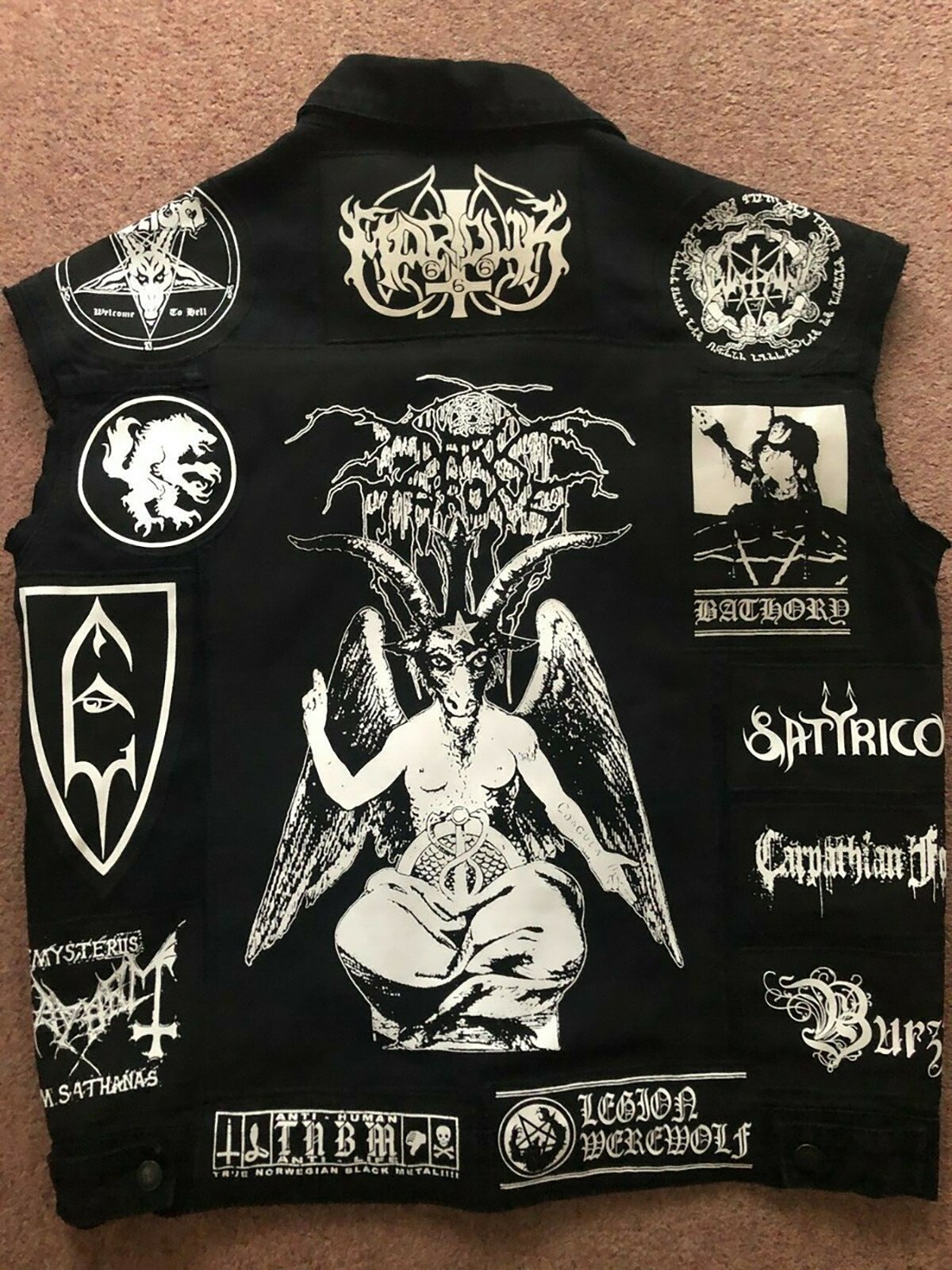
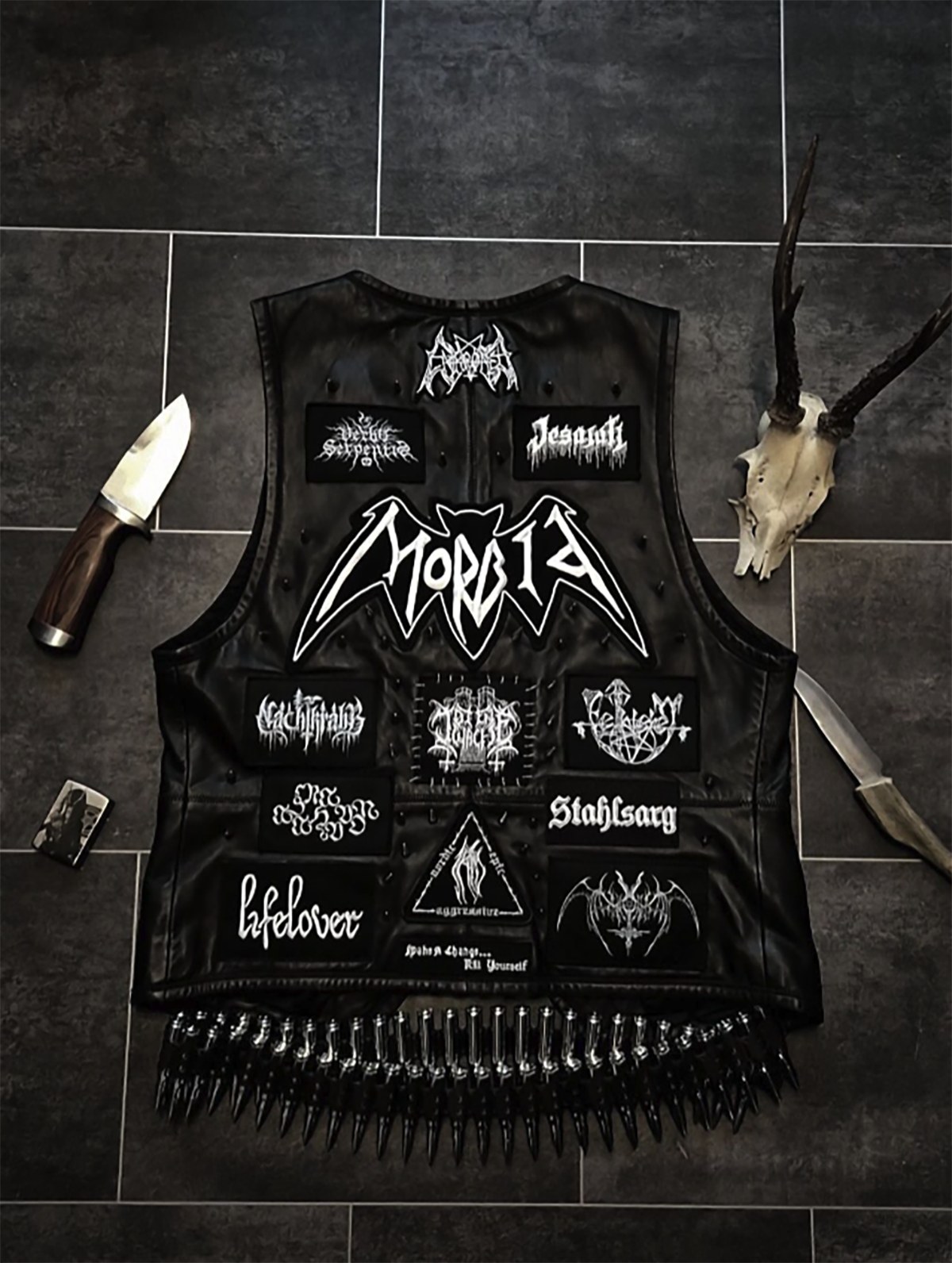
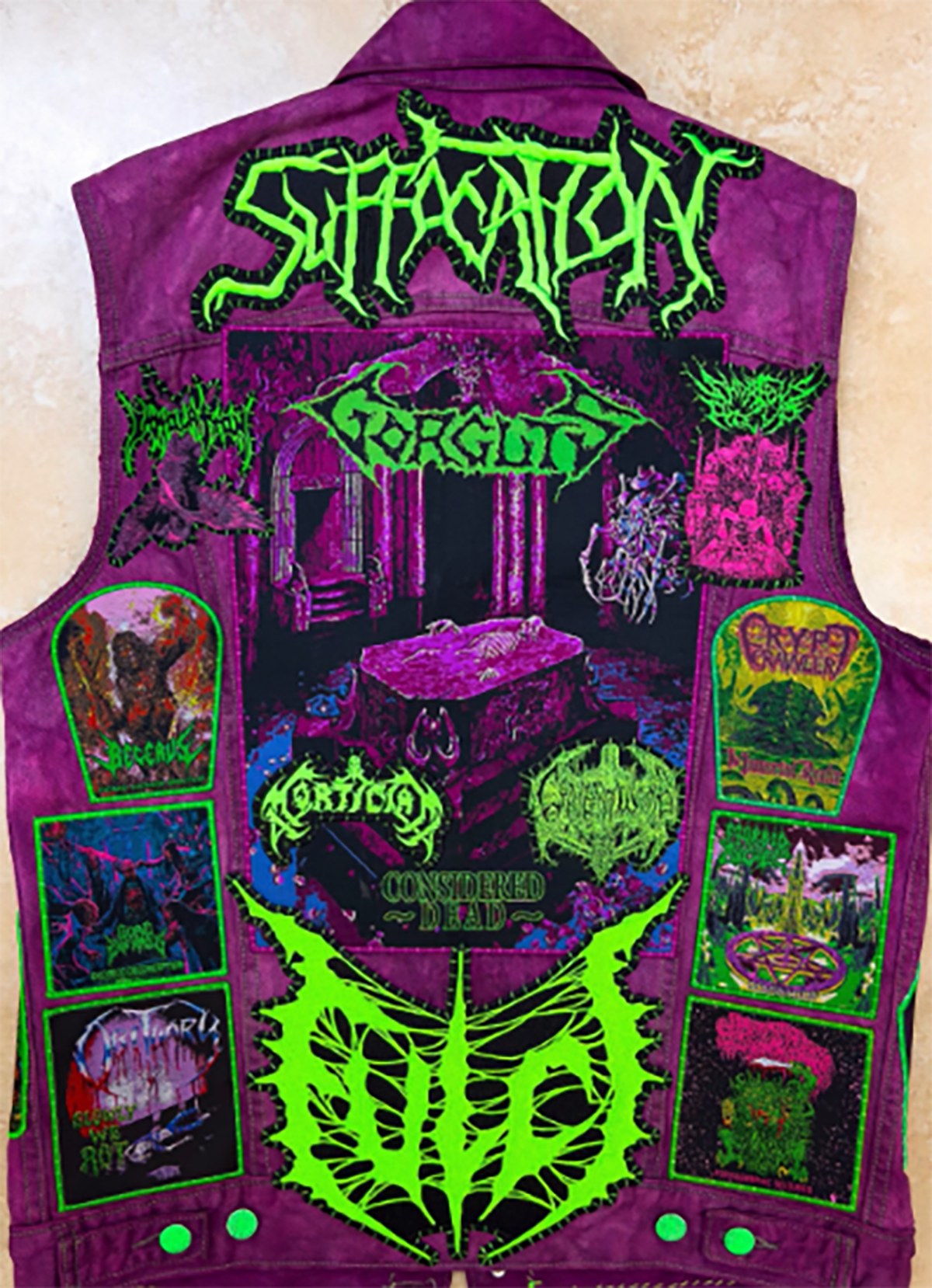
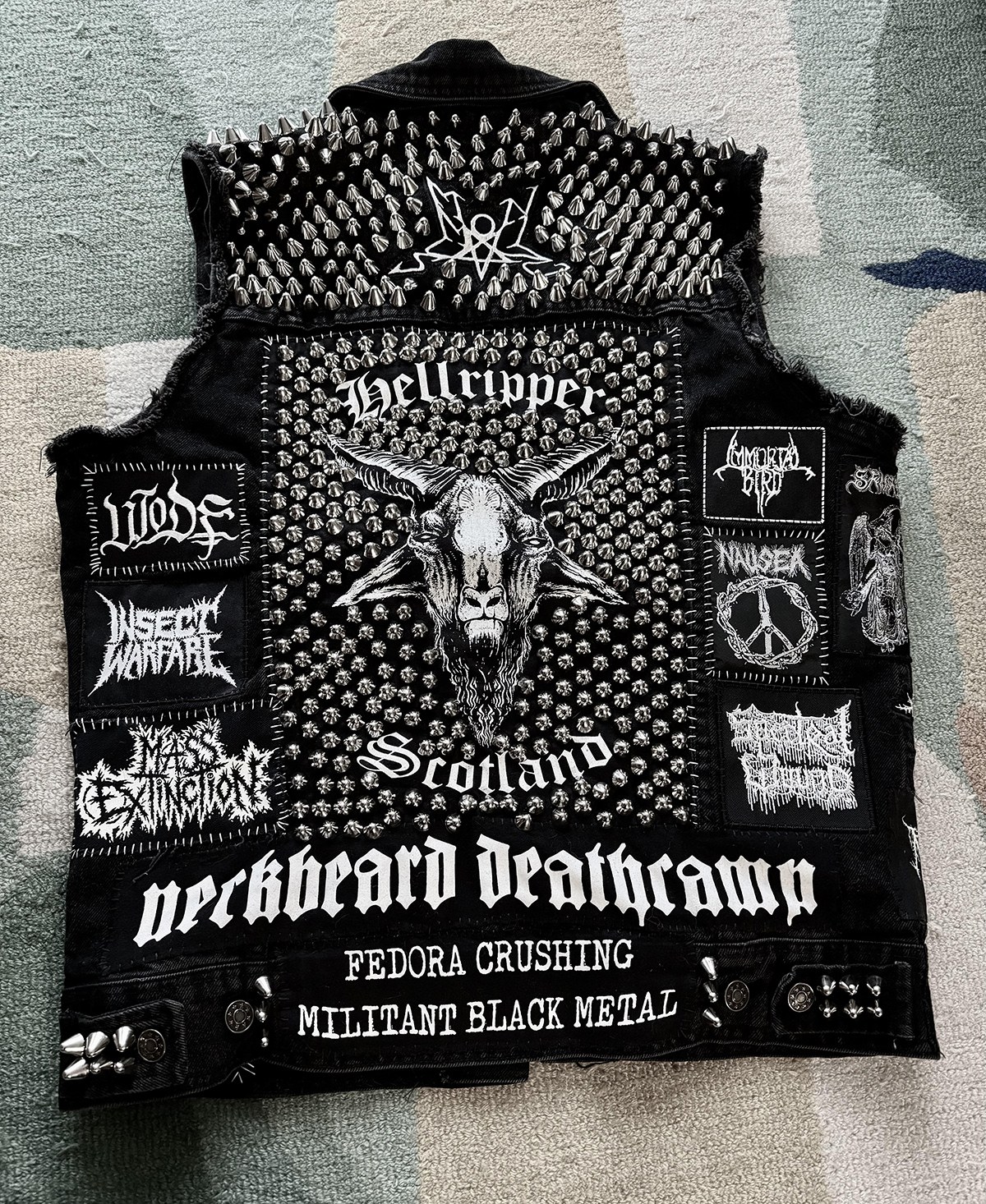
The early eighties were the high point of this culture. The NWOBHM in Britain and thrash metal in America brought the jackets of musicians and fans alike to the fore. In 1981 Saxon simply called an album and its title song "Denim and Leather". Most jackets were built on the Type III denim jacket that Levi Strauss designed in the early sixties. The back of this cut has a broad rectangle bounded by the shoulder yoke and the side panels. The composition Cardwell describes is built around that rectangle: in the middle, the large back patch of the favourite band; around it, a tight grid of small patches; horizontal logos along the shoulder yoke; and at the waist, the wide strip patches known as "superstrips". The front, broken up by buttons and pockets, is left to badges, studs and festival wristbands. Sewn-on festival wristbands sit on the chest like military ribbon bars.
Unwritten rules
The rules of this surface are not written down, but most makers know them. The most common is to sew on patches only for bands you truly love. Some make it conditional on owning the band's record, others on having seen the band live. Another is never to sew on two patches from the same band; "tribute" jackets devoted to a single band are the exception. Some argue that a jacket should stay faithful to one genre, only nineties death metal, say, or black metal. A maker named Pete, interviewed by Cardwell, ties the rule to biker jackets: you earn a patch only by doing something, by being there. Some push back. For Simon Springer, founder of the patch maker Pull the Plug Patches, the real rule is that there are no rules.
Working from fifty jackets gathered on Instagram and Reddit, O'Hagan distinguishes three types: the "classic" jacket, a biography of its owner's musical life; the "tribute" jacket, which carries ties to loved ones; and the "modern" jacket, which puts political or religious views to the fore. These rules are a reminder that the battle jacket is also an instrument of exclusion. The right patch shows how deeply the fan is immersed in the scene; the wrong patch, or a jacket bought ready-made, shows that they have come from outside. One fan Cardwell interviewed sums it up as "insider outsiders": you are outside the mainstream, but inside that outside.
Black metal, the army and a lean period
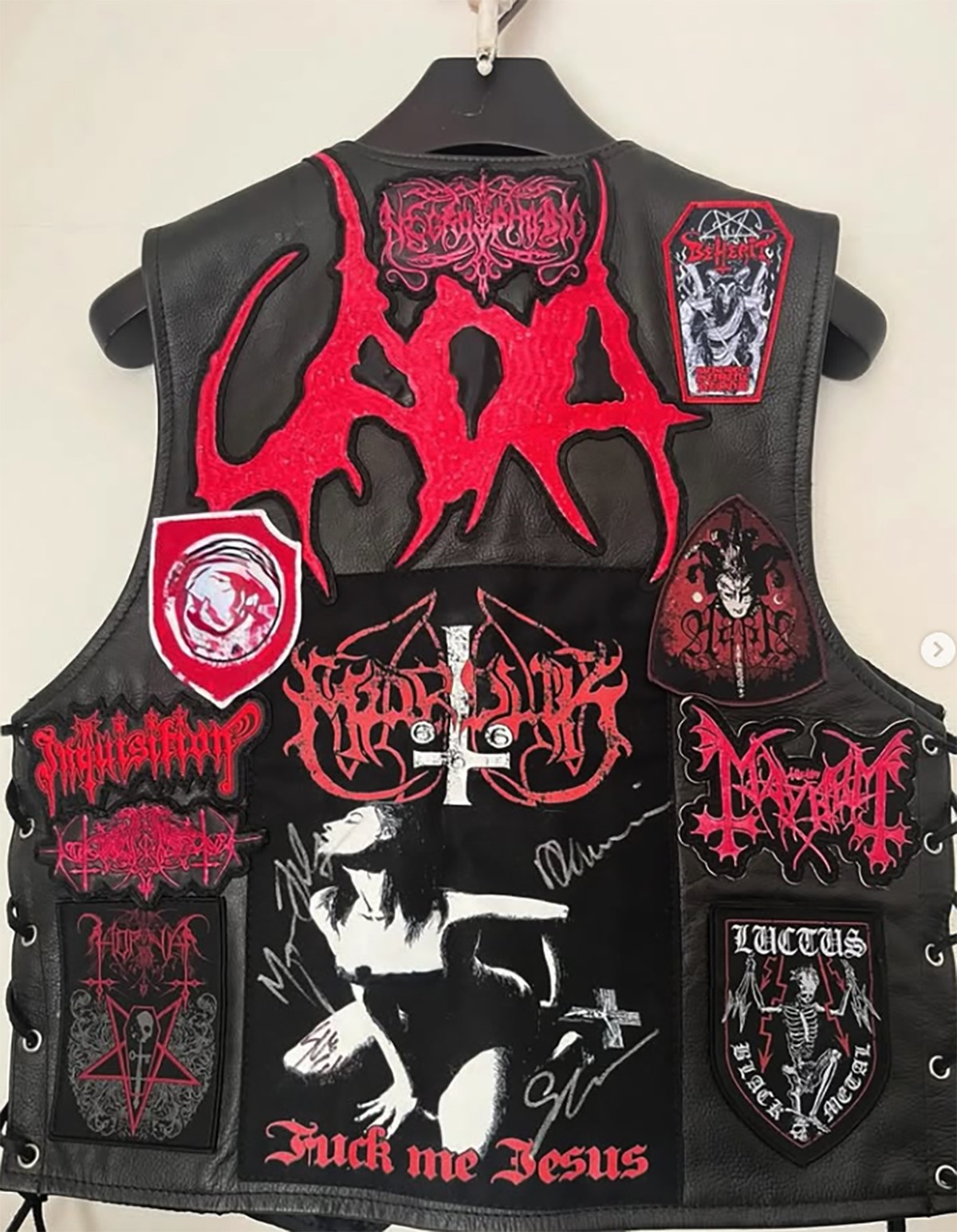
When grunge and nu-metal changed the way metal fans looked in the nineties, the patched vest withdrew for a while. According to Cardwell, even then jacket culture carried on in extreme genres such as black metal and death metal. He points to Death Archives, the book collecting Mayhem's 1984-1994 archive, as a source for this continuity. Black metal brought military imagery back to this surface more openly than any other genre. Cardwell cites Watain's Black Metal Militia design as an example of band artwork that directly imitates military insignia. The lineage that began with the Second World War flight jacket turns here into a militia's insignia.
From the 2000s on, interest in the older metal genres returned, and jacket making went through a renaissance. Cardwell attributes this rebirth partly to the nostalgia of ageing fans. A patch seller he interviewed says that a good share of his customers are people who sold or lost the jacket of their youth and now want to make it again.
Needle and thread
Denim and leather were long associated with working-class masculinity. Writing in 1985, Philip Bashe left women metal fans two options: dress like the men, or imitate the goddesses of the music video. Yet the battle jacket itself undoes this story of masculinity from within. As Cardwell points out, the jacket is sewn by hand, and embroidery is still considered women's work in many cultures. The queer scholar Amber Clifford-Napoleone reminds us that the leather and studs of metal style drew on queer BDSM dress; Judas Priest singer Rob Halford is the most visible example of that link. Two women makers Cardwell interviewed say that men build their jackets on a very orderly, military grid, while they themselves prefer an arrangement that is a little crooked and untidy.
On the world's back
Today the battle jacket does not belong to the West. Malaysian fans set particular store by tracking down original patches of eighties and nineties death and thrash bands. In Indonesia, patch collecting has grown into a large culture on social media. In Nepal, the cost of metal merchandise relative to local wages pushes fans towards making their own. Botswana's "cowboy metalheads" wear leather rather than denim, sewing Iron Maiden and Cannibal Corpse patches onto their leather vests. Everywhere, the same grid is rebuilt with local material and on a local budget.
Another study by O'Hagan, published the same year, follows the jacket of Pär, a Swedish fan, step by step. Pär bought his jacket with sleeves, but cut them off straight away. His reason is brief: making a vest felt more real to him. In time the jacket without its sleeves filled with patches and became a record in which every patch calls up a memory of its own.
Source note
- Academic sources
- Tom Cardwell, "Battle Jackets: Wearing Metal Identity" (Cambridge Companion to Metal Music, 2023)
- Tom Cardwell, Heavy Metal Armour (Intellect, 2022)
- Lauren O'Hagan, "My Musical Armor" (Rock Music Studies, 2021)
- Lauren O'Hagan, "The Anatomy of a Battle Jacket" (Journal of Contemporary Ethnography, 2021)
- The Mongols case
- NPR and NBC News (February 2019)
- ACLU
- Courthouse News (January 2023)
- Hollister and the "one per cent" story
- RideApart (2011)
- Badmags
- Bobber Brothers
- Japan
- Japan Times, tokkōfuku feature (2021)
- Japan Ministry of Land, Infrastructure, Transport and Tourism, multilingual commentary database: Edo-period war coat
- Quotations
- The prosecutors' phrase "like armour" and the words of Pete, Springer and Pär are paraphrased from the English originals.